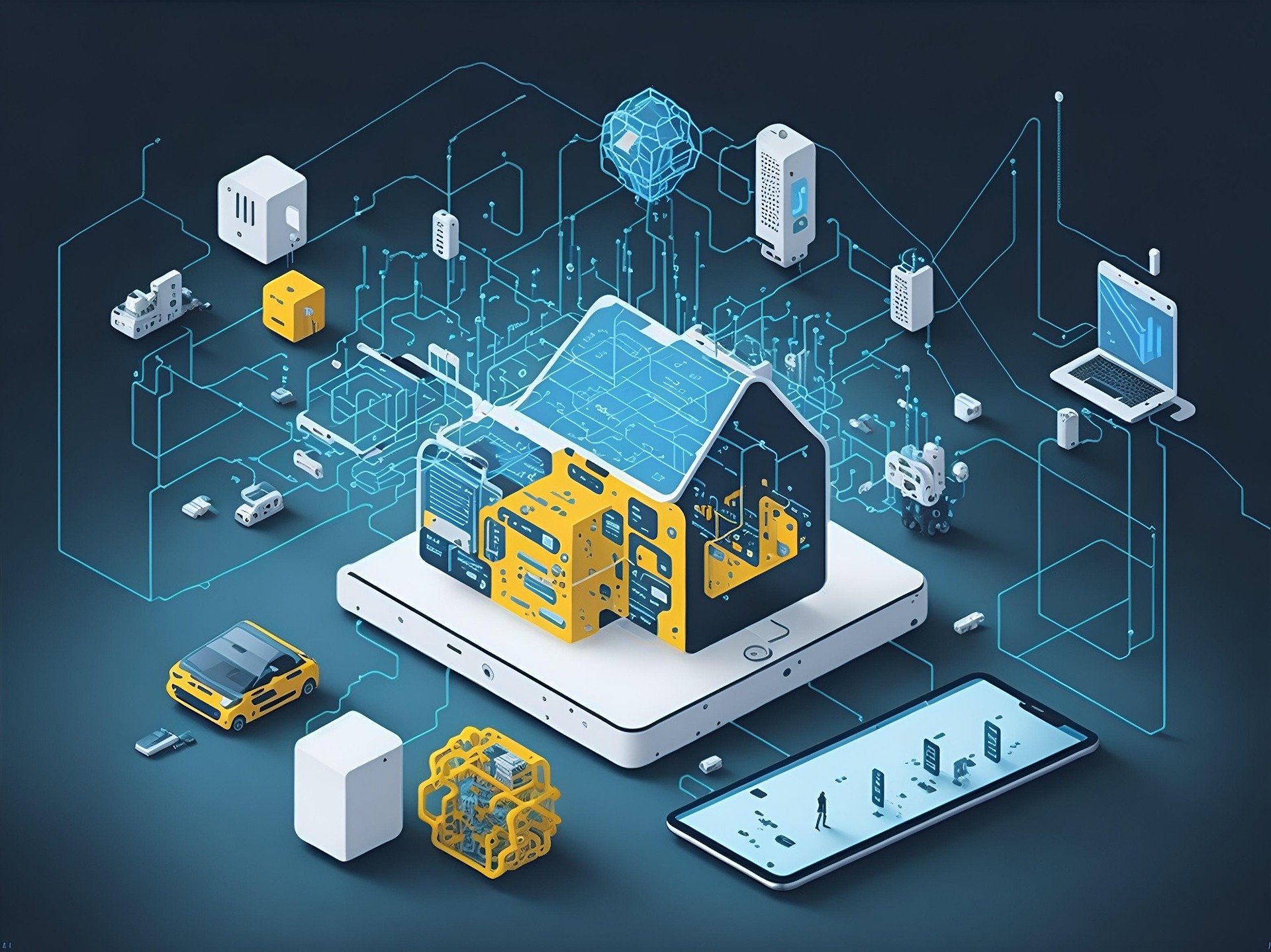
IoT Product Development: From Sensor to Cloud
The Internet of Things has changed how businesses monitor equipment, manage physical assets, automate operations and interact with connected products. However, building a successful IoT product involves much more than connecting a sensor to the internet.
A production-ready IoT solution must combine hardware, embedded firmware, communication protocols, cloud infrastructure, databases, application interfaces, security and analytics into one reliable ecosystem.
This guide explains the complete IoT product development process, from selecting sensors and microcontrollers to building cloud dashboards and intelligent automation capabilities.
What Is an IoT Product?
An IoT product is a physical device or system that collects information from its environment, communicates with software platforms and enables monitoring, analysis, alerts or remote control.
Examples of IoT products include smart energy meters, equipment-monitoring devices, environmental sensors, asset-tracking systems, connected healthcare devices, industrial monitoring platforms and smart home products.
A complete IoT system usually contains several interconnected layers.
IoT Device Layer
The device layer contains the physical components responsible for sensing, processing and controlling real-world operations.
It can include sensors, microcontrollers, processors, actuators, displays, communication modules and power-management components.
Embedded Firmware Layer
Firmware is the software that runs directly on the embedded device.
It manages sensor readings, local processing, communication, device configuration, error handling, power usage and actuator control.
Connectivity Layer
The connectivity layer transfers information between the device, gateway and cloud platform.
Common connectivity options include Wi-Fi, Bluetooth, BLE, GSM, MQTT, HTTP, LoRa, Zigbee, Modbus and CAN communication.
Cloud and Backend Layer
The backend receives, validates, processes and stores information from connected devices.
It can also manage device authentication, users, alerts, remote commands, APIs and integrations with other business applications.
Application Layer
The application layer allows users to view information and interact with the system.
It may include web dashboards, mobile applications, administrative portals, reports, notifications and remote-control interfaces.
Analytics and Intelligence Layer
The analytics layer converts raw device information into useful business insights.
It can include historical analysis, anomaly detection, forecasting, predictive maintenance, pattern identification and automated decision support.
Why Businesses Invest in IoT Product Development
IoT systems give businesses continuous visibility into physical operations that were previously difficult to monitor.
Instead of depending entirely on manual inspections, businesses can receive real-time readings, automated alerts and historical reports.
Real-Time Monitoring
Connected devices can continuously measure equipment conditions, environmental parameters, energy usage and operational activity.
Remote Device Access
Users can monitor and control distributed devices through web or mobile applications without being present at every location.
Faster Issue Identification
Automated alerts can notify teams when sensor readings or equipment behaviour move beyond expected limits.
Operational Automation
IoT systems can automate repetitive monitoring, control and reporting activities.
Data-Driven Decision Making
Historical device data can help businesses understand usage trends, identify inefficiencies and improve planning.
Predictive Maintenance
Sensor readings such as vibration, temperature and current can help identify abnormal equipment behaviour before major failures occur.
Key Stages of IoT Product Development
A successful IoT product is built through a structured engineering process.
Step 1: Define the Business Problem
The project must begin with a clear business objective.
The team should understand what needs to be monitored, controlled, predicted or automated.
Important questions include who will use the system, where the devices will operate, what information is required and what business outcome is expected.
Step 2: Define Functional Requirements
Functional requirements describe what the IoT solution must do.
Examples include reading temperature every minute, sending an alert when vibration exceeds a threshold, displaying device history and allowing administrators to control equipment remotely.
Step 3: Understand the Deployment Environment
The operating environment affects every technical decision.
Indoor and outdoor systems may require different enclosures, communication methods, sensors and power solutions.
Industrial environments may also introduce vibration, dust, moisture, electrical noise and temperature variations.
Step 4: Select Sensors
Sensors must be selected according to accuracy, operating range, response time, reliability, calibration requirements and cost.
A low-cost sensor may be sufficient for basic environmental monitoring but unsuitable for safety-critical or industrial measurements.
Step 5: Select the Microcontroller or Processing Platform
The microcontroller processes sensor readings and controls device behaviour.
Common development platforms include ESP32, ESP8266, STM32, Arduino-compatible boards and Raspberry Pi.
The selection depends on processing requirements, connectivity, power consumption, memory, available interfaces and production goals.
Step 6: Select the Communication Technology
No single communication technology is suitable for every IoT application.
Wi-Fi is useful when local network access and sufficient power are available.
Bluetooth and BLE are useful for nearby device communication and mobile onboarding.
GSM or cellular connectivity can support devices deployed away from local networks.
LoRa can support long-range and low-data-rate applications.
MQTT is commonly used as a lightweight messaging protocol between devices and cloud platforms.
Step 7: Develop Embedded Firmware
Firmware must reliably collect sensor readings, process data and communicate with the cloud.
It should also handle connectivity failures, invalid sensor values, device restarts and unexpected operating conditions.
Important firmware capabilities include local buffering, retry mechanisms, configuration storage, watchdog handling and secure communication.
Step 8: Build the Cloud Backend
The backend receives information from connected devices and makes it available to users and applications.
A typical IoT backend may contain device APIs, user authentication, databases, alert rules, analytics services and administrative controls.
The architecture should be designed to support future increases in devices, users and data volume.
Step 9: Create the Database Architecture
IoT platforms may generate large volumes of time-based information.
The database structure should support device identification, sensor readings, timestamps, users, alerts, locations and configuration details.
Retention policies should also be defined so that unnecessary data does not increase storage costs indefinitely.
Step 10: Develop the Web Dashboard
The dashboard presents device information in a format that users can understand.
Useful dashboard elements can include live values, status indicators, historical graphs, maps, alerts, device health and downloadable reports.
Different users may require different levels of access through role-based permissions.
Step 11: Develop the Mobile Application
A mobile application can support device onboarding, notifications, real-time monitoring, remote control and user configuration.
The app may communicate with the cloud platform, directly with a device through Bluetooth or with both.
Step 12: Add Alerts and Notifications
Alerts allow the system to respond when important events occur.
Notifications can be delivered through email, mobile push messages, SMS, WhatsApp integrations or dashboard alerts.
Alert rules should be carefully designed to avoid sending too many unnecessary notifications.
Step 13: Implement Security
IoT security must be considered across the complete system.
Security measures can include device authentication, encrypted communication, secure credentials, role-based access, protected APIs and audit logging.
Default passwords and hardcoded production credentials should be avoided.
Step 14: Test the Complete System
Individual components may work correctly while the complete system still fails during real use.
Testing should include sensor accuracy, connection loss, delayed communication, invalid readings, power interruptions, device restarts, API failures and user-permission checks.
Step 15: Deploy and Monitor
After deployment, the platform should monitor device health, backend errors, communication failures, application performance and unusual activity.
A production IoT product requires ongoing observation and maintenance rather than a one-time release.
How Machine Learning Improves IoT Solutions
IoT systems generate continuous streams of operational information.
Machine learning can analyse this information to identify patterns that simple threshold rules may miss.
Predictive Maintenance
Machine learning models can analyse equipment readings and help estimate maintenance requirements.
Anomaly Detection
Models can identify unusual device or sensor behaviour compared with normal historical patterns.
Condition Classification
Equipment conditions can be classified into categories such as normal, warning or critical.
Demand and Usage Forecasting
Historical IoT data can support energy, resource or equipment-usage forecasting.
Intelligent Automation
Machine learning predictions can be used to trigger recommendations, alerts or automated actions.
Cloud AI Versus Edge AI
IoT intelligence can operate in the cloud, on a local gateway or directly on the device.
Cloud AI provides access to greater computing resources and centralised model management.
Edge AI reduces network dependency and can provide faster responses.
The correct approach depends on latency, privacy, hardware capability, cost and connectivity requirements.
Common IoT Product Development Challenges
IoT projects involve multiple technical domains, which creates unique challenges.
Unreliable Connectivity
Connected devices may experience weak networks or complete communication loss.
The firmware should buffer data and retry communication safely.
Sensor Accuracy
Incorrect sensor selection or poor calibration can make an otherwise well-designed system unreliable.
Power Consumption
Battery-powered devices must carefully manage communication frequency, sensing activity and sleep modes.
Device Management
Large deployments require methods for identifying, configuring, monitoring and updating individual devices.
Security Risks
Weak device authentication or exposed APIs can create serious security vulnerabilities.
Scalability
A prototype built for five devices may not work efficiently when expanded to thousands of devices.
Data Overload
Collecting information too frequently can increase storage, bandwidth and processing costs without adding useful business value.
Integration Complexity
The device, cloud platform, dashboard, mobile application and external systems must exchange information consistently.
IoT Prototype Versus Production Product
An IoT prototype proves that the main technical concept can work.
It may demonstrate sensor readings, connectivity and a basic dashboard.
A production product requires additional engineering for security, reliability, maintainability, device management, data retention, monitoring and deployment.
Businesses should not treat a successful prototype as a finished production system.
Choosing an IoT Development Partner
An IoT development partner should understand both embedded engineering and software development.
The team should be able to connect sensors and firmware with cloud APIs, databases, dashboards, mobile applications and analytics.
It should also communicate technical limitations clearly and design the system according to real operating conditions.
GitSpire Technologies combines IoT, embedded systems, artificial intelligence, machine learning, web development, mobile applications and cloud integration within one engineering ecosystem.
Our approach focuses on building complete connected solutions rather than isolated hardware or software components.
Industries That Can Benefit from IoT
Manufacturing companies can use IoT for equipment monitoring, production visibility and predictive-maintenance data collection.
Logistics companies can monitor vehicles, assets, movement and storage conditions.
Agriculture businesses can monitor soil, irrigation and environmental parameters.
Energy companies can track consumption, voltage, current and equipment conditions.
Healthcare technology companies can build connected monitoring devices and assisted-care platforms.
Smart-building solutions can monitor energy, access, environmental conditions and equipment operations.
Retail businesses can use connected systems for inventory, environmental monitoring and store analytics.
Final Thoughts
Successful IoT product development requires careful coordination between hardware, firmware, connectivity, cloud infrastructure, databases, applications and security.
The technology should be selected according to the business problem and operating environment rather than based only on current trends.
A well-designed IoT system can improve visibility, automate operations, reduce manual work and create new intelligent capabilities for physical products.
GitSpire Technologies helps businesses move from connected-device ideas and prototypes to secure device-to-cloud platforms with dashboards, mobile applications, analytics and machine learning integration.
Frequently Asked Questions
What is IoT product development?|IoT product development is the process of designing connected devices and the firmware, communication, cloud infrastructure, databases and applications required to operate them.
What components are required for an IoT solution?|A complete IoT solution can include sensors, microcontrollers, firmware, communication modules, cloud APIs, databases, dashboards, mobile applications and analytics.
How long does it take to build an IoT product?|A basic prototype may take a few weeks, while a production-ready IoT platform can require significantly more time depending on hardware, firmware, integrations, applications and testing.
Can machine learning be used with IoT devices?|Yes. Machine learning can support anomaly detection, predictive maintenance, forecasting, classification and intelligent automation using IoT data.
What is the difference between IoT and embedded systems?|An embedded system performs dedicated functions inside a device. IoT extends embedded systems by adding connectivity, cloud communication, remote monitoring and data-driven applications.
Can an existing machine be connected to an IoT platform?|Many existing machines can be connected using external sensors, gateways, communication modules or industrial protocols, depending on their available interfaces.
Does an IoT product require a mobile application?|Not always. Some IoT systems use only web dashboards, while others require mobile applications for onboarding, notifications, remote control or field access.
What is edge AI in IoT?|Edge AI means running artificial intelligence or machine learning processing on a device or nearby gateway instead of relying entirely on the cloud.
How is IoT data secured?|IoT security can include device authentication, encrypted communication, protected APIs, access permissions, secure credential management and activity logging.
Does GitSpire Technologies develop complete IoT solutions?|Yes. GitSpire Technologies can support embedded hardware integration, firmware, cloud backends, databases, web dashboards, mobile applications and machine learning integration.